
Competitions
Choose the program you’re watching for its game overview and scoring guide.
VEX IQ — Level UpShow game detailsHide game details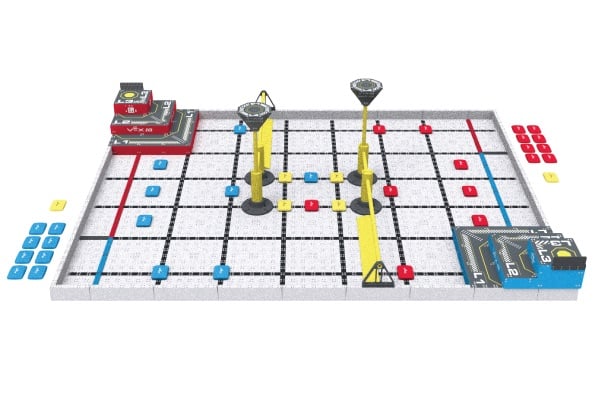
How the game works
Two teams work as one alliance on a 6 × 8-foot field. Their robots move bean bags into goals, carrying one at a time. Higher goals earn more points.
Teams decide which goals to aim for. They also choose between driving the long way around the field and building a robot small enough to fit through narrow shortcuts. Cheer for both teams: they are partners, building one shared score together.
Each Teamwork Challenge match lasts one minute. Two student-built robots work together for one shared score.
Both teams aim for the same result: the highest combined score.
What earns points?
Points per scored bean bag, highest goal first
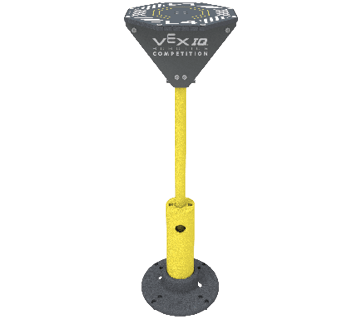
Level 4 goal
Yellow bags only
16 points
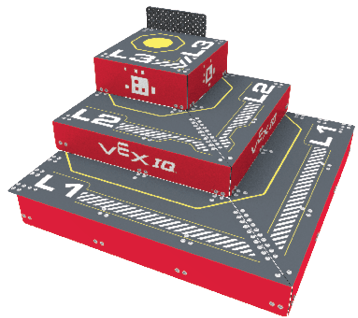
Pyramid goal
- Level 3
- 12 points
- Level 2
- 6 points
- Level 1
- 3 points
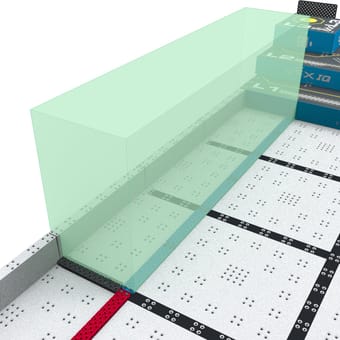
Floor goal
1 point
Match the bag to the goal
Floor and Level 1–3 goals accept bags matching the goal’s color, or yellow bags. A red or blue bag in the wrong-colored goal does not score.
Save yellow bags for the highest goals
Level 4 goals accept yellow bags only, worth 16 points each. Yellow bags can also score in lower goals for those goals’ point values.
Watch the game
Transcript
Welcome to the 2026-2027 VEX IQ Robotics Competition and this year's game... Level Up. Level Up is played on a 6 foot by 8 foot field by two teams, red and blue, working together to maximize their score. The scoring elements are rectangular beanbags measuring 3 inches by 4 inches and are one of three colors: red, yellow, or blue. There are 38 beanbags in Level Up. 20 of them start on the field: 8 blue, 4 yellow, and 8 red. 16 more bags begin outside of the field as match loads with 2 additional yellow bags reserved for use as preloads. Beanbags can be scored in multiple locations around the field. There are 2 floor goals and 2 multi-level pyramid goals located at opposite corners of the field. Each pyramid goal has 3 levels of scoring height and relative difficulty. There are 2 eight inch tall fences that create a path for robots as they navigate the field. Alternatively, robots that are small enough to drive under the fence can save valuable time, but will find it more difficult to drive back the way they came. Teams will need to transport beanbags across the field and deliver them to a goal of a matching color. Yellow bags can be scored on any goal and are worth the same amount of points as a color matching bag at any level.
A single beanbag scored in a floor goal is worth 1 point. A level one platform is worth 3 points, level two is worth 6 points, and level three is worth 12 points. But the challenge doesn't stop there. In the center of the field, stand two platforms that are classified as Level 4. These platforms are reserved exclusively for the placement of yellow bean bags and have a width of only 7 inches, but a height… of 24 inches. Each bag scored on a Level 4 Platform Goal is worth… 16 points. Teams must work together to determine the most efficient way to play as object possession is limited... to one beanbag at a time. There are 3 ways to play in the VEX IQ Robotics Competition: First, two teams collaborate in 60 second Teamwork Challenge Matches working together to maximize their collective score. Each of these teams consists of two drivers and one loader. One driver operates the robot for the first half of the match, the other driver operates it for the second half, and the loader performs their task for the full seconds. Second, each team has the opportunity to play driving skills challenge matches. In these matches teams have 60 seconds of driver controlled time to score as many points as possible.
Third, each team also has the opportunity to play autonomous coding skills challenge matches in which they have 60 seconds of autonomous robot operation to score points. No drivers allowed. The scores from driving and autonomous coding skills challenges will be combined to determine a robot skills challenge champion. For official game rules and robot requirements for VEX IQ Robotics Competition Level Up, be sure to check out the game manual found at competition.vex.com. To register a team, find events near you, or ask a question on the official Q&A, please visit events.vex.com. Good luck and have a great season!
Watch the official game video on YouTube
Key terms
- Alliance: official definition
- The two teams paired for a match. They play together, not against each other, and both get the same score.
- Autonomous: official definition
- When a robot moves on its own, using only code the students wrote. In VEX IQ, this happens in Autonomous Coding Skills matches.
- Finals: official definition
- The last matches of an event. The top-ranked teams are paired up, and each pair plays one match. The pair with the highest score is the Teamwork Champions.
- Skills match: official definition
- A one-minute match where one robot plays alone and scores as many points as it can. In Driving Skills, a student drives. In Autonomous Coding Skills, the robot runs only on the students’ code. Skills scores are ranked separately from Teamwork Challenge matches.
- Teamwork Challenge match: official definition
- A one-minute match where two teams’ robots work together for one shared score. There is no opposing team.
Official definitions of these and other terms: game manual glossary
Source: Official VEX game manual
VEX V5 — OverrideShow game detailsHide game details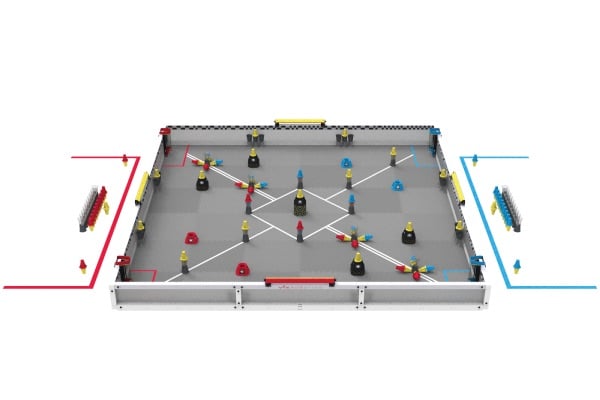
How the game works
Two red teams face two blue teams on a 12 × 12-foot field. Each pair works together as an alliance to earn the higher score.
Robots stack pins and cups on goals. Each pin has two halves, colored red, blue, or yellow. A toggle on the field wall turns to red, blue, or yellow to decide who gets the points for the yellow halves in its part of the field. Robots also try to end the match in the midfield, the square in the center of the field.
Each match lasts two minutes: 15 seconds autonomous, then one minute 45 seconds driver controlled. Four student-built robots compete as two alliances.
First, student-written code runs the robots. Then students take the controls.
What earns points?
Standard VEX V5 match scoring
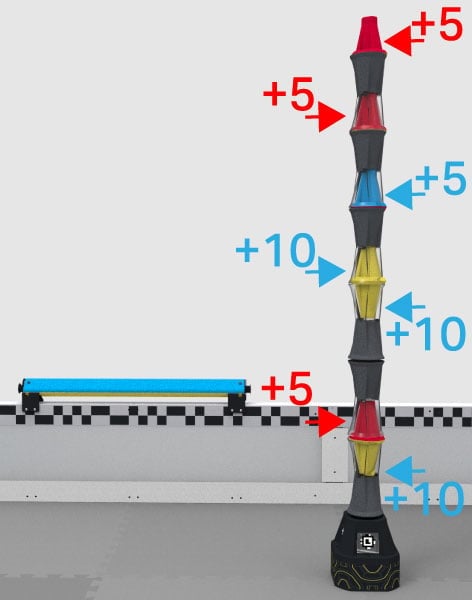
Pin halves in a goal
Each visible, scored half
- Red or blue half
- 5 points
- Yellow half your alliance owns
- 10 points
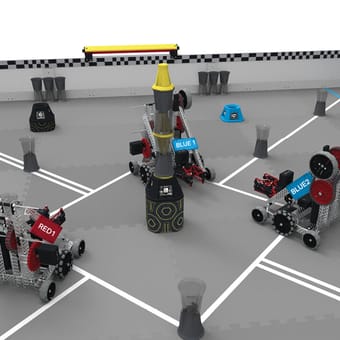
Midfield
Each robot ending in the midfield
8 points
Autonomous bonus
Alliance ahead after the first 15 seconds, when robots run on student code. A tie gives each alliance 6.
12 points
Which pin halves count?
Red halves earn points for red, and blue halves earn points for blue. Only halves you can see count. A half sitting down inside a goal, or hidden inside the solid half of a cup, does not score.
Watch the toggles
Each quadrant’s toggle assigns its scored yellow halves to red or blue. A neutral yellow toggle gives those points to neither alliance. One flip can change who earns them.
Why the midfield matters
Each robot ending at least partly in the midfield earns 8 points. The alliance with more robots there also gets the points for yellow halves in the midfield goal. A tie gives those yellow points to neither alliance.
What is the autonomous bonus?
The first 15 seconds of every match are called the autonomous period. During this time, the robots operate on their own using code written by the students, with no driver control. The alliance with the higher score at the end of this period earns 12 bonus points. If the scores are tied, each alliance earns 6 points. Midfield positioning does not count toward this bonus. Rule violations can change the award.
Watch the game
Transcript
Welcome to the 2026-2027 VEX V5 Robotics Competition and this year's game... Override!
Override is played on a 12ft by 12ft field by two alliances, one red and one blue, made up of two teams each. There are 119 scoring objects in Override: 56 cups and 63 pins. Cups are hollow, hourglass shapes with one opaque side and one transparent side. Pins come in four different configurations: Red/blue, red/yellow, blue/yellow, and yellow/yellow. Points are scored by stacking pins and cups on top of goals. The addition of a cup allows teams to increase the number of pins that goal can hold. There are 9 different goals located around the field, 5 of them are neutral and can be used be either alliance. The remaining 4 goals are red or blue and can only be used by their designated alliance. Goals can be one of three sizes, and all of them are equipped with AprilTags for vision sensor identification, regardless of starting alliance. 10 cups and 11 pins begin in the driver station where they can be introduced to the field together or individually using a loader. A stack is created by adding a cup to a pin scored in a goal. Only a pin’s visible color will count as scored. When adding cups and pins, teams must take note of the orientation of the previously placed object in the stack, as placing a pin into the opaque side of a cup prevents that color from being scored.
The match begins with robots in their designated starting positions with one red/yellow or blue/yellow preload each. Override consists of a 15 second autonomous period where teams can win an autonomous bonus of 12 points, as well as an autonomous win point. Once the autonomous winner has been determined, the 1 minute, 45 second driver control period begins, where teams will work together to score more visible pins than the opposing alliance. There is no limit to the number of scoring elements that are allowed to be placed on a goal. However, until the end of the match, each robot's vertical expansion is limited to 50 inches tall. Each visible red and blue pin is worth 5 points, and every visible yellow pin is worth... zero points... until they are claimed by an alliance using a toggle. Toggles have the ability to change the color assignment of any visible yellow pins within one of four quadrants. For example, a stack that includes one red pin and two yellow pins has a score of 5 points for the red alliance, while the toggle is yellow. If that quadrant’s toggle is changed to red, the red alliance’s score for that stack increases by 10 points for every yellow pin. However, if the toggle is changed to blue, then all yellow pins within that stack will count toward the score for the blue alliance.
Teams will need to use pins strategically as there are limited quantities of each color combination: 20 red/yellow pins, 20 blue/yellow 19 yellow/yellow pins, and only four red/blue pins. But at any given time, each robot is only allowed to possess one cup and one pin. In the final 10 seconds of the match, alliances have one last chance to turn the tide of the game. During this time, robots within the midfield boundary may not exceed a total height of 18 inches and must do their best to avoid being forced out of the midfield by the opposing alliance. Any robot breaking the plane of the midfield in any way at the end of the match will receive 8 points. But that's not all... The alliance that stands their ground with the greatest number of robots inside the boundary when the clock runs out will claim the points of all yellow pins scored on the center goal. And to make things interesting, This season, teams must accommodate a build restriction as your robot's drivetrain may not exceed 55 watts. Override can also be played in robot skills challenges, the collegiate level VEX U Robotics Competition and the VEX AI Robotics Competition. Check out the game manual for all the details. Official rules and game information for Override can be found at competition.vex.com To register a team, find events near you, or ask a question on the official Q&A, please visit events.vex.com.
Good luck and have a great season!
Watch the official game video on YouTube
Key terms
- Alliance: official definition
- Two teams whose robots play together in a match. A red alliance plays a blue alliance.
- Autonomous period: official definition
- The first 15 seconds of a match. Robots move on their own, using only code the students wrote. No one drives.
- Autonomous Win Point: official definition
- An extra point for the team rankings, not the match score. Before the finals, teams are ranked by Win Points: 2 for a win, 1 for a tie. An alliance earns 1 more if its robots finish a set list of tasks in the autonomous period, such as scoring pins in at least two goals, without breaking a rule. Both alliances can earn it.
- Driver controlled period: official definition
- The rest of the match, 1 minute 45 seconds. Students drive the robots with controllers.
- Finals: official definition
- The last matches of an event, which decide the champions. The top-ranked teams choose their partners. An alliance that loses a match is out, until one alliance is left.
- Midfield: official definition
- The square in the center of the field, marked with white tape. Robots try to end the match there.
- Quadrant: official definition
- One of the four triangle-shaped areas of the field around the midfield. Each has two goals and one toggle.
- Skills match: official definition
- A one-minute match where one robot plays alone and scores as many points as it can. In Driving Skills, a student drives. In Autonomous Coding Skills, the robot runs only on the students’ code. Skills scores are ranked separately from matches against other teams.
- Toggle: official definition
- A three-sided bar on the field wall, one in each quadrant. Robots turn it to show red, blue, or yellow. The color shown decides which alliance gets the points for yellow pin halves in that quadrant. Yellow means neither alliance gets them.
Official definitions of these and other terms: game manual glossary
Source: Official VEX game manual
VEX AIR — Pick & DropShow game detailsHide game details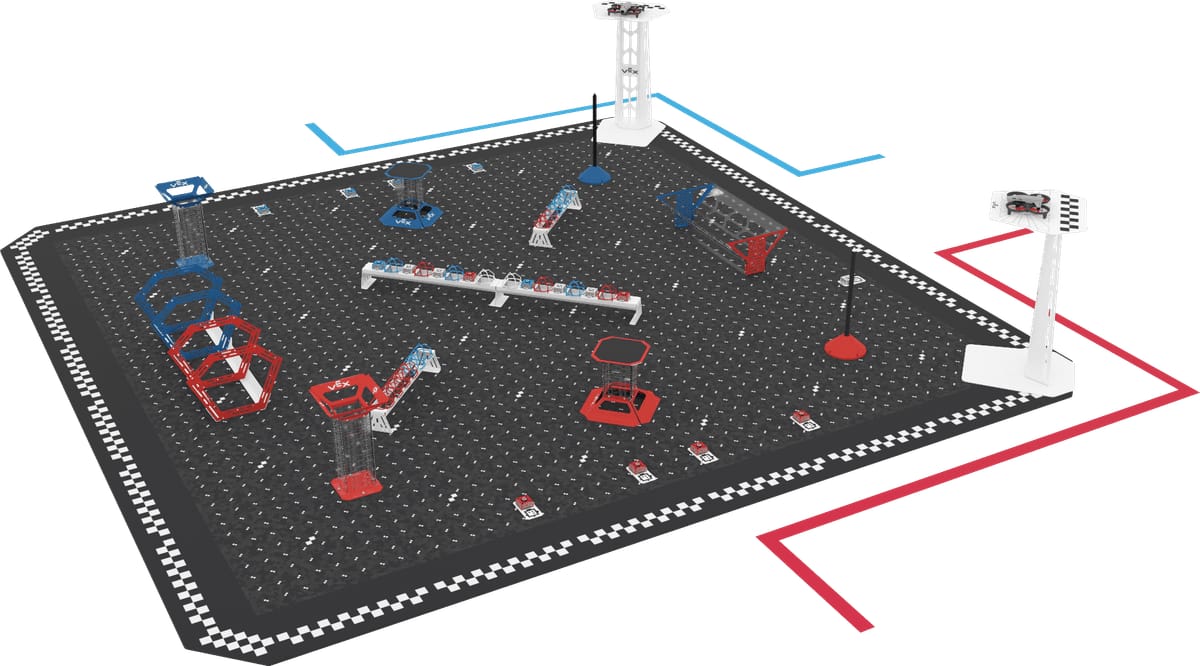
How the game works
Two teams fly two drones together on a 12 × 12-foot field. They pick up Orbit Balls and Cargo, deliver them to seven goals, fly through a four-ring tunnel, and return to landing platforms.
Three minutes. Two drones. One shared score. Cheer for both teams as they coordinate their flights and decide which tasks to tackle together.
The point values can change from round to round. Watch how the students adjust their plan to the scoring system announced for their match.
What earns points?
The point values change during the event. Before each round (a group of matches), the event announces one of six scoring systems, A to F, and shows it on the event screens. Choose that letter to see its points. Not sure which one is in use? System A is the standard set.
What counts as scored never changes. White Orbit Balls and Cargo count as matching either goal color.
Point values for Scoring System A
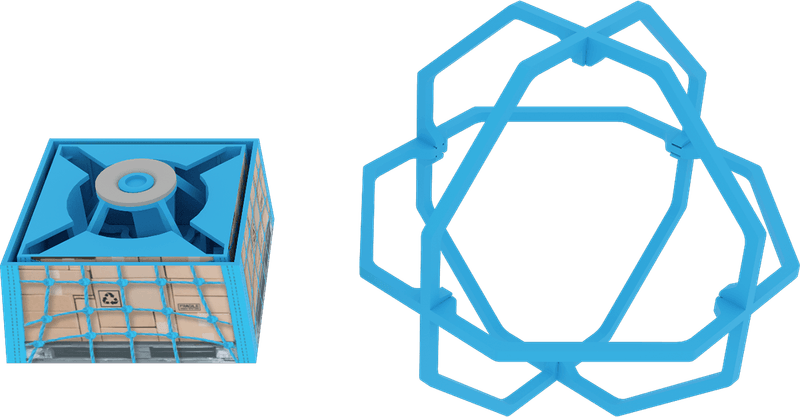
Orbit Ball
Scores in or on a goal
Cargo
Scores on a Cargo Platform
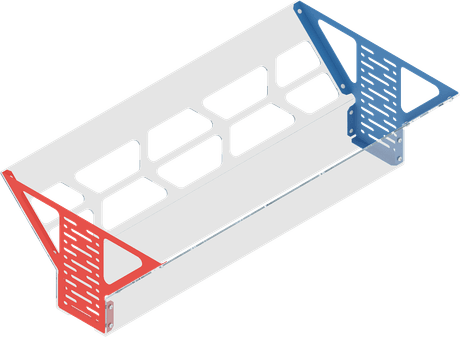
Drop Zone
Each Orbit Ball
1 point
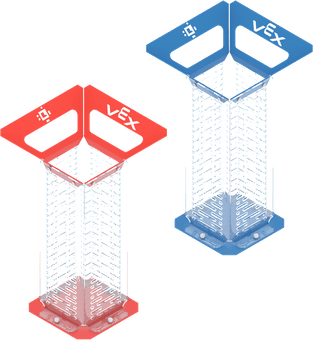
Drop Tower
Each Orbit Ball
- Matching color
- 4 points
- Other color
- 2 points
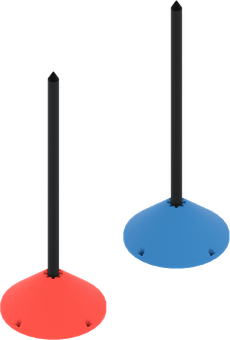
Pole Goal
Each Orbit Ball
- Matching color
- 5 points
- Other color
- 3 points
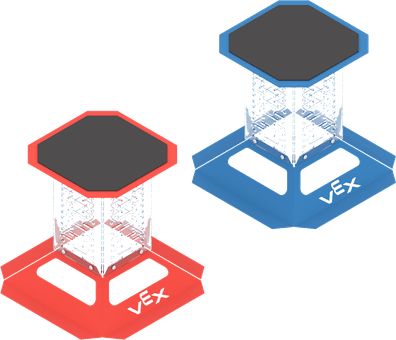
Cargo Platform
Each Cargo
- Matching color
- 6 points
- Other color
- 4 points
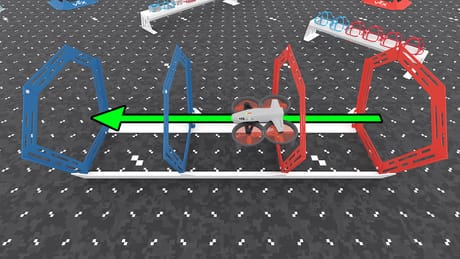
Ring tunnel pass
Fly through all four rings in order without touching the tiles. Two passes max.
5 points per pass
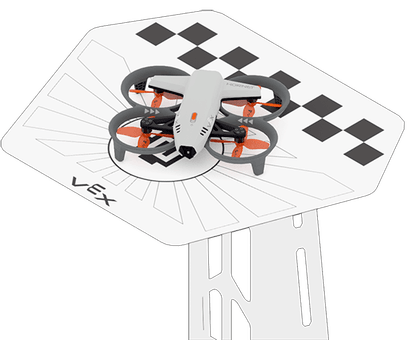
Landing
Each drone on a field platform at match end
5 points per drone
Goal bonus
Each goal containing at least one scored object
10 points
Obstacle completion bonus
One tunnel pass plus one landed drone earns one bonus. Two passes plus both drones landed earns two. Either drone can make the passes.
5 points per bonus
Watch the landing
All four feet must finish on a platform, with no scoring object touching the drone. A drone still flying when time reaches zero is held in the air while referees check the landings. It earns no landing points, even if it lands afterward.
What is Drone Skills?
One team flies one drone for 90 seconds. In Piloting Skills, a student flies it. In Autonomous Skills, the students’ code flies it without human control. Skills always uses System A, and a team’s ranking combines its best score from each type. Only one obstacle completion bonus is available in a Skills match.
Key terms
- Alliance: official definition
- Two teams whose drones fly together in a match and share one score. Partners are assigned at random until the finals, when teams choose them.
- Finals: official definition
- The last matches of an event. The top-ranked teams choose a partner, and each alliance flies one match. The alliance with the highest score wins.
- Module: official definition
- An official attachment for the drone. There are three kinds: Passive, Motorized, and Magnetic.
- Pilot: official definition
- The student flying the drone with a controller.
- Round: official definition
- A group of matches that use the same scoring system.
- Scoring system: official definition
- One of six sets of point values, A to F. The event announces which one each round uses. Only the points change, never what counts as scored.
Official definitions of these and other terms: game manual glossary
Source: Official VEX AIR game manual
Awards
Awards vary by event. These are examples of awards an event may offer, recognizing match results, engineering, coding, communication, and sportsmanship.
| Award example | What it recognizes |
|---|---|
| Excellence Award Judged | Outstanding engineering, communication, and competition performance. |
| Design Award Judged | A student-driven engineering process, documented and clearly explained. |
| Think Award Judged | Strong coding, programming, and software development. |
| Teamwork Champion Performance | The two teams on the alliance with the highest score in the finals. |
| Tournament Champion Performance | The two teams on the alliance that wins the finals. |
| Robot Skills Champion Performance | The team with the best combined score from its driving and autonomous coding Skills matches, where one robot plays alone. |
| Sportsmanship Award Nominated | Respect, fairness, integrity, and positive conduct throughout the event. |
Judged awards come from a short interview where students explain their robot and process, their Engineering Notebook, and what judges see during the event. An Engineering Notebook is the team’s record of how it designed, built, tested, and improved its robot. Performance awards come from match and Skills results. For nominated awards, event volunteers such as referees, along with the judges, suggest teams that show respect and good conduct.
Read the full Awards Offered at Competition Events from the Global Robotics & Science Foundation.
Awards vary by event. Larger events present more awards. These are the awards a VEX AIR event may offer, recognizing planning, flying, coding, and teamwork.
| Award | What it recognizes |
|---|---|
| Excellence Award Judged | The highest honor at an event: strong flying results, a strong planning process, and students who can explain their own work. |
| Mission Planning Award Judged | How a team plans, tests, and improves its flight strategy, shown in its Mission Notebook and interview. Larger events also award 2nd and 3rd place. |
| Teamwork Champions Performance | Both teams on the alliance with the highest score in the finals. Neither drone wins alone. |
| Overall Skills Champion Performance | The team with the best combined Piloting Skills and Autonomous Skills score. |
| Autonomous Skills Champion Performance | The team with the best Autonomous Skills score, where the students’ code flies the drone. Offered at larger events. |
| Piloting Skills Champion Performance | The team with the best Piloting Skills score, where a student flies the drone. Offered at larger events. |
Judged awards come from a short interview where students explain their flight plans and code, their Mission Notebook, and what judges see during the event. A Mission Notebook is the team’s record of its goals, tests, and changes; it is required for judged awards but not to compete. Performance awards come from match and Skills results.
Find your event and its awards at VEX Events.
Student-Centered
In the VEX Robotics Competitions, student-centered means the students do the work: they design, code, test, and operate their robot, plan their strategy, and make the decisions behind it. Parents and mentors have a real role: they teach, ask questions, and support the team, helping with the work but never taking it over. The result is a team that can explain every part of its work, because the students did it themselves.
Teams ask themselves three questions:
- Are we doing the work?
- When we get help, does it teach us?
- When we use an outside idea, do we make it our own?
Yes to all three means our team is student-centered.
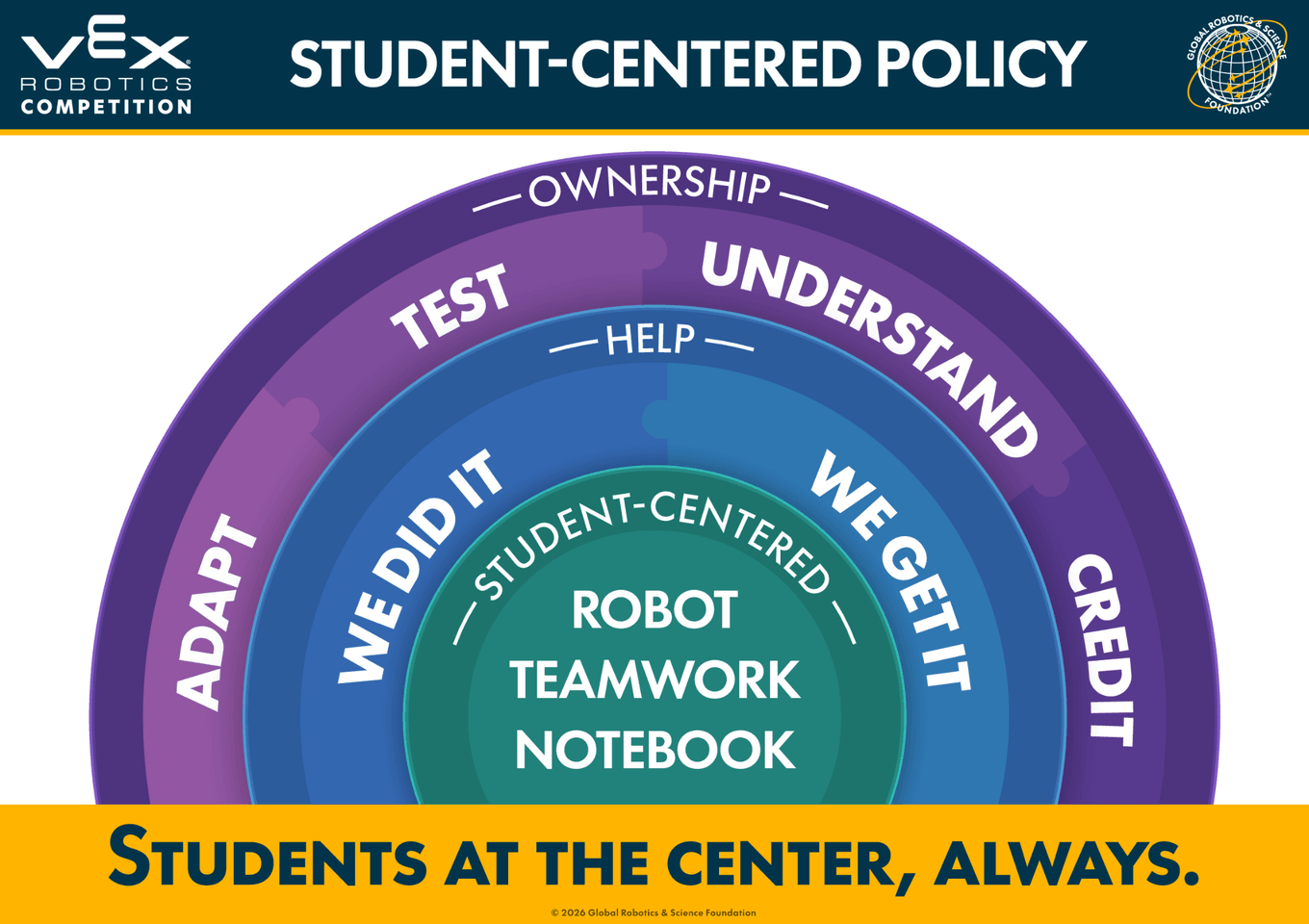
Read the full Student-Centered Policy from the Global Robotics & Science Foundation.
In the VEX AIR Drone Competition, student-centered means the students do the work: they configure, code, test, and pilot their drone, plan their strategy, and make the decisions behind it. Parents and mentors have a real role: they teach, ask questions, and support the team, helping with the work but never taking it over. The result is a team that can explain every part of its work, because the students did it themselves.
Teams ask themselves three questions:
- Are we doing the work?
- When we get help, does it teach us?
- When we use an outside idea, do we make it our own?
Yes to all three means our team is student-centered.
Read the full Student-Centered Policy from the Global Robotics & Science Foundation.
Code of Conduct
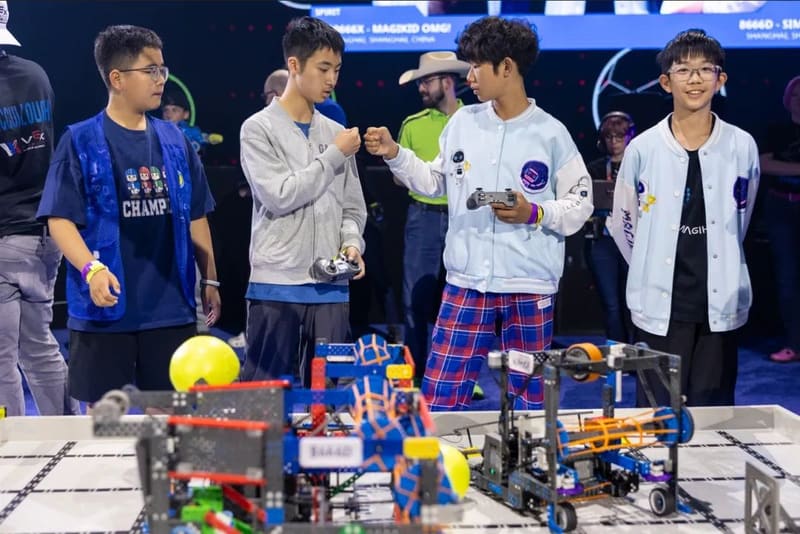
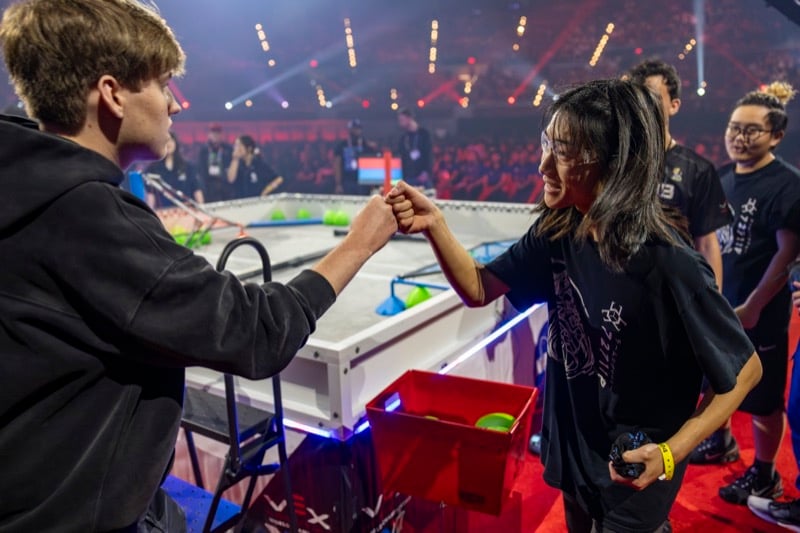
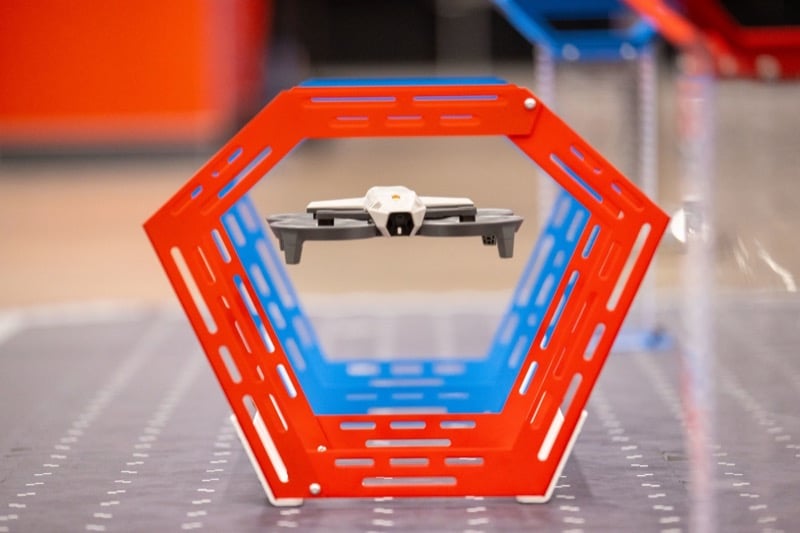
Great competition. Good people.
What students learn here depends on everyone feeling safe, valued, and treated fairly. The Code of Conduct applies to all of us, on the field and in the stands.
- Safety: Put student safety first, always.
- Respect: Treat every person with respect.
- Learning: Let students do the work and make their own decisions.
- Integrity: Compete honestly and accept the result.
- Fairness: Follow the rules, and expect everyone to follow them too.
- Reporting: Report concerns and violations. We protect those who do.
Read the full Code of Conduct from the Global Robotics & Science Foundation.
For the Adults
Adults make student-centered learning possible.
- Let students speak for themselves. When students talk to judges, officials, inspectors, or other teams, do not answer for them.
- Protect the learning. Students are learning teamwork, communication, problem-solving, resilience, and integrity. Do not put winning a trophy ahead of those lessons.
- Encourage, do not control. Help students prepare. In competition, the decisions and the work are theirs.
- Stay calm about results. Close matches and losses are part of competition. If a team thinks a referee made a wrong decision, a student from the team can ask the head referee about it right after the match. The head referee’s decision is final.
- Respect every role. Volunteers, officials, Event Partners (the people who organize the event), parents: treat them all as partners in the student experience.
- Keep students safe. Interact in open, observable spaces. Keep communications visible to parents and other adults. Never ask a student to keep a secret. Report concerns right away to the Event Partner or Global Robotics staff; you do not need to be certain. Suspected abuse must also be reported to local authorities.
Read the full Youth Protection Policy from the Global Robotics & Science Foundation.
Some Robots Look Alike?
Students are solving the same game challenge, so they often come up with similar ideas for their robots. They learn from their own experiments and from seeing what other teams have tried. As they test and improve their ideas, some designs begin to look alike. This is called design convergence.
Each team has a story of learning to share. Ask students how their robot works, what they improved, and what they’re excited to try next. Celebrate the creativity, teamwork, and persistence behind their progress.
Read the full Design Convergence: Why Robots Look Alike on VEX PD+.
VEX AIR teams use the same official competition drone and approved accessories. Students make the difference through their module choices, code, practice, teamwork, and flight strategy.
Each team has a story of learning to share. Ask students why they chose their module, how their code works, and how they improved their flights. The equipment may look alike, but every team should understand and explain its own decisions.
Read the VEX AIR Drone rules and the Student-Centered Policy.
Get Involved
Today you’re in the audience. Tomorrow, you could help make it happen.
- Volunteer — Explore event roles and help your local competition run.
- Mentor — Share what you know. Help students discover what they can do.
- Start a team — Bring the experience to your school or community.
A note about photos and video
Events may be photographed, filmed, or livestreamed, and footage may be used in promotional, educational, and media materials. Check your event’s media notice for details.